Are Thief Player Characters Still Relevant?
 |
| Albrecht Dürer - Cupid the Honey Thief. 1514 |
It's not that I think that the entire skill system is bad for the game, I just feel that systems like Pathfinder and modern D&D have allowed it to take center stage. It controls too much! People have gotten too reliant on them, and use the skill system to bypass fun parts of the game. It alters the flow, speeding it up, and I feel that it interferes with immersion.
To make a long story short, specifics can correct the problem of mechanical interference, but that doesn't mean that we should completely scrap the NWP system; and then we have the thief class. A skill based class that relies upon them to function.
In a game where the traps are specific, we know how they function and the players can locate them with tools or equipment, and come up with a plan which may or may not result in disarming them, where does the thief fit into this?
- Thieves are more expendable.
- They can figure out the hidden workings of advanced traps.
- They do more for the team than just disarm and locate traps.
Handling Checks
In my last post, I suggested that we try to stick to specifics as much as possible. The DM listens to the plan, and translates the odds of success to the d%; however, there are times when the players are going to have to make checks. In times like these, I prefer the d20. It is fast, fair, and usually in the player's favor.
d% Thief Checks
 |
| via: Pinterest |
As a player, the thief skill system doesn't work at early levels of play and offers no challenge at higher levels. The best games are when you are gambling with your character's life. As a player, if something is dangerous, I'm not going to even attempt it unless I've got at least a 70%. If things get desperate, I may attempt it at 50%, but never below that. If something has no risk, I will just sit there and roll dice until we all get bored or it works . . . hours and hours later in game time. That sucks, and that isn't playing the game.
I know that there is a huge population of gamers who think that the NWP system is broken, but I don't feel that it is, of course, the way that I design my games I enforce no reliance upon the system to use it. It can allow a user to bypass an obstacle, or make a section easier if you are successful, but play doesn't stop because of a failed check; that is a symptom of bad design. It all boils down to percentages, the d20 just uses increments of 5%. If a character has a DEX of 15, with a -2 to his ability check, he's got a 65% of succeeding. That is actually lower standards than I would normally allow for a dangerous task that will kill me if the dice say no.
PLAYER'S OPTION: SKILLS & POWERS
It was this book that got folks prepared for 3e. It focused on a reliance on skills over the traditional game. It even stripped the class system that we all loved in favor of building some character class that made it even slower to roll up new characters, and caused players to stop play to look at the weird rules in this thing. I hated it. I'm still not a fan.
Regardless if you like the book or not, it did say something interesting . . . if you could find it. It suggested turning thief skills into NWP. How stupid is that? I mean, it goes against years and years of tradition! Besides, thief players aren't going to want to sacrifice NWP slots on skills that they used to have from the start of the game, right?
RAVENLOFT: Masque of the Red Death
This boxed Campaign setting actually predates the Skills & Powers book, but it had lots of mechanics which were unique to it. It isn't a medieval fantasy game, this one takes place in our world during the 1890's. It altered all of the classes, but the most affected were the Thieves.
All of the characters had been depowered, there are no super-heroes in this game, what makes them playable is the skill system, however, this still isn't a skill based game. You aren't going to find the Pathfinder like rules which are overly strict, you pick your skills which define your character, and you play. The skills are passive. You still use specifics over rolling the dice, but I digress.
Thieves are no longer a class. While the other classes still use skills, the class that is dependent upon them is called Tradesmen. If a character doesn't use magic, and can't be defined as a soldier, they automatically become Tradesmen, thus, this is the dominant class.
 |
| via Pinterest |
As a fan of thieves, this method works great! I always preferred to play against the grain. I never played The Greymouser type thieves, I could probably count the times that I've used Pick Pockets on one hand, and I never started building it up until I was satisfied with my other scores. It just sat there, ignored. In this system, I don't have to pick it at all! I can replace it with some other skill that I want instead, something useful to me and how I want to play my character.
But wait . . . didn't I just say that Skills & Powers was stupid?
It is. It provides very little motivation to play-test the ideas held within it, however, this system has been play-tested at my table, and it works. It works amazingly well! Masque of the Red Death, to myself and the other members of the club, made D&D fun again. Its higher level of challenge changed not just how we game, but how we see the game itself.
- Thieves are all different
- Thief skills work from the start
- The challenge is consistent, regardless of level
- The thief skill system does not place limitations upon the system as a whole
But Percentages gave more to the game than yes or no answers
As a player, I was always torn. I like rolling my own results, but sometimes I wanted the DM to keep the actual results a secret from me. I wanted to simulate thinking that I'm moving silently but not really being sure if I am or not. As a DM, these thoughts were amplified, but I was stuck because I couldn't figure out how to simulate the event without taking away player agency. This system actually allows that.
Either the DM can translate the d20s into percentages, or tell the player who succeeded their check that they believe that they have found a route which is possible to move silently and hide in shadows, then get confirmation that they still want to do the action or not. If they do, then the DM rolls the percentile check to see exactly how quiet they are.
The point is that no matter what we do, we've taken the traditional Thief Skills System, which was closed and set in its way, and changed it into a Skill System which allows the player and the DM to open it up when they want to.

THE DOWNSIDE OF THE SYSTEM
- Players can no longer get a 95% chance of success
- A perceived penalty imposed on low ability scores
- Player's who do want to play traditional thieves hate this
- A psychological loss of control
- Requires a talented DM to function
- Cleaner Character Sheets
- The Level Cap has been removed
- Custom Characters without breaking the system
- Fast and Easy NPCs who are competent without cheating
- Creating Hirelings that grow with the game and aren't static
- Easier to level up (and level down)
- Rewards Imaginative Play
- Skills can be given to Races without weird limitations
Before closing, something needs to be addressed. Since the players are spending slots on abilities, should they get more slots to spend? The answer is no. They still get the same amount. This is balanced by the abilities themselves being useful as soon as they are chosen.
Unmodified skill checks do place caps on abilities. DEX of 18 = 90%, and on the low end, 9 = 45%.
The 3d6 method of STAT Generation prefers to give results in the 11-13 range, which gives you some good numbers that are fun to gamble with, 55%-65% but aren't fixed in my games, they go up and down. If you choose, the Thief Ability Table found in the 2e DMG can be used in conjunction with this system if you need to lean on it now and then. Since the system is open, we can change the difficulty level of a task as we see fit.
Most of the time, it really doesn't matter. The core Thief System is a nitpicker. Either the thief can pick a lock, or he can't. The players can decide to break the door, spend a spell opening the door, or ignore the door and walk away from it. Who cares if the Thief picks a lock? Why impose that restriction at all?
.
Streamlining The AD&D Skill System

Since writing that article, I have unknowingly adopted a set of house-rules that allows more freedom for everybody based on principles I've learned from researching Original Dungeons & Dragons and have a deeper understanding of how players interacted with the world before those systems were in place.
It goes back to Open & Closed systems. The NWP system is designed to be closed, but it is also designed to be opened up by the players and the DM when it needs to be. What defines this need is the level of detail.
REDEFINING THE SKILL SYSTEM
The proficiencies are guidelines, they help players get a clear idea of who their character is. They are tools which a player can use to tell the DM that they can do something very well.
Having a proficiency is a pass. The player is not limited to these skills, but having these skills defined and written down allows that player to use them, and get extra-XP for using them well.
Owning a Proficiency is proof that your character can definitely do this, and may even go beyond what is defined in the handbook.
USING A SKILL

This system is primarily the total domain of the player, DMs don't use this system, only players do. It is up to the players to remember these things and use them wisely. Since having a skill is a pass, when the DM asks how the character knows something, and they refer to the specific skill, the conversation is either over, or the DM can have them roll a skill check if that needs to happen.
It is also up to the player if they want to risk rolling the dice to perform a task or to start a dialog and get specifics.
Example: The player has an investigative skill which allows a methodic search of an area via the dice. The player can automatically use this when searching a room, but a failure is a failure. Alternatively any player, even those that do not have this skill, can ask for details. They can interact with the setting and the DM will tell them the results. Once this is done and the player believes that they have exhausted the place, they can say that they would like to do a skill check, and see what happens.
ACQUIRING PROFICIENCY SLOTS
The idea that a character only knows what is on the character sheet is preposterous and self-limiting for no real benefit to the player or to the game. The DM is going to have to invent fast throw-away mechanics at the table on a case-by-case basis. Specifics dictate what can and cannot be done. Doing something that you aren't proficient at on a regular basis may equal gaining a proficiency.
For instance, if the game is played in the mountains for several months, the players are going to have a really good chance of understanding what they are doing. How can we translate this though?
- The DM can just have them roll a STAT check to see if they picked it up, and just give it to them if they are successful.
- The Player can write it in once a new Prof. slot becomes available if they chose to.
- All slots beyond those chosen at the creation of the character are left blank until a skill is learned through specifics.
There is a myth about open Skill systems, that goes along the lines of the Player taking advantage of the DM. Players going out of their way to change the tone of the game. The player CAN try anything, however, every hair-brained scheme takes the time to execute, time that the player probably doesn't have. I've been playing this way for a while now and so far my players have all embraced the tone of the game and do their best to preserve it.
As DM, I reserve the right to ask the player how they learned this new skill, if they can't tell me, they don't get it. My players so far have written down things that would have been handy in the past. Things that they had picked up along the way but I didn't give it to them for free, and I do give out skills for free if they had been earned.
The question, "How did you learn this?", is a good governor for the skill system. Slots don't have to be filled up right away, and the question goes back to the player; "How can I learn this skill?"
Torches: We are doing them wrong
 Forgotten Arts & Crafts, Wilderness Survival Guides, American Indian crafts and Depression Methods are among my favorite Non-Fiction Book Subjects. Simple living comes in handy regardless of income.
My father raised us to remember these things and see their value. My grandfather believed that electricity was a fad, and preferred the old ways more often than not. He had a tractor, but for tedious jobs such as picking corn, he took the horse and cart out to the fields, his logic being that the horse just kept following him, he didn't have to stop working to go move the machine.
I do the same thing for my children, I raise them to be self-reliant and to know where they came from. It has been hard to adjust to city life, but I am doing my best. For vacation we tend to go camping, there are many important skills that one can learn from primitive camping, the most important being self-reliance.
In regards to light, we have modern battery-powered lanterns, but we leave them at home. Those things are terrible! They do nothing but draw bugs and batteries are very expensive compared to other forms of fuel. Instead, we use railroad lanterns. Not only is the fuel cheaper (and a hell of a lot cleaner!), but the light doesn't draw insects and doesn't kill your night vision.
 Torches, these are easy to make, and we've done it! They suck. The fire itself blinds you, in fiction, they always have the person in the lead carrying the torch, but it should be the person in the back, though it does get passed around a lot. The torch-bearer really can't see very far, you can't even see the ground which is a problem, and it is harder than you think to hold a torch above your head and out of your eyes. Even a lantern will do the same thing unless it is fixed with a shield, you don't want the light to be too bright, just bright enough.
 Cab drivers who drove at night had to keep the flame itself out of their eyes, seeing the ground was imperative because of potholes. Nobody wanted to drive at night, even with a light source, because moving around is dangerous. People did it, but people also got lost on their own properties and drowned in rivers.
In regards to cave exploration, torches aren't the best idea. The best option is a candle, low levels of light to highlight your surroundings. They told you more than just your surroundings, the flame is sensitive to changes in air quality, professional miners preferred candles to lanterns, it wasn't just budget concerns. Even today you'll see a lot of miners smoking, they watch the smoke to see the air flow. Once battery operated light came about, that is when people started carrying canaries.
 One would be shocked at how deep the old-timers got inside of caves, and these weren't professional spelunkers, these were just everyday locals who took some time off and wanted to see things that nobody else had seen. They used candles, and they'd climb deep inside of these things until they either got scared, ran out of time, or could progress no more because of the muck. They'd mark their spot with their name and usually the date, and these writings are still in there.
What does this have to do with D&D games? Nothing. We're dealing with fantasy, it is just easier to have tunnels that you can stand upright in, the rule-of-cool dictates a lot of stuff! I do give them raw caves to explore when I want to. Passages that aren't 5'x5'. I'll also get picky about supplies if that is the game, but we rarely play that game.
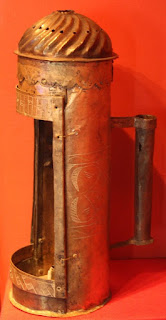
Elves can see normally at night above ground, starlight is enough, but it is reversed, the Dwarvish folk needs to carry a light source.
Candles are preferred, lanterns break, but the oil can be used to make a torch. To light a torch you only need one stick, but you've got to bring enough cloth and fuel with you. The problem with light is that it gives your position away. Enemy sentries typically sit in the dark, living spaces are lit, but that is it. Golin will sometimes light passages to help sentries see intruders sneaking around in the dark (if they are paying attention), so light itself is part of their survival plan.
The players tried to utilize the Permanent Light Spell, which works great in unoccupied caves and dungeons, but since you've got to put it out to sneak around, and recast it, it can be terribly expensive.
That is the game that we prefer to play. One of stealth. I have also found that it is difficult to put a torch out, the fastest way is with water, a slower way is to smother it with dirt, the slowest way is to tap and roll it around on stone, which is also noisy. I don't think that I've ever used these experiments in a game before. Maybe stripping it off with a sword real quick and stamping it out would work? That might be a fun game!
Subscribe to:
Comments (Atom)
My Blog List
-
-
Best Books of 2025 - By tradition, December is marked on the 25th by Christmas Day, on the 24th by Christmas Eve, on the 26th by Boxing Day, on the 31st by New Year's Eve, an...6 days ago
-
Making the Best of Roleplaying Games Like Draw Steel and Daggerheart With Player-Driven Turn Orders - The post Turns and Turn Order Are the Worst, so Why Do Roleplaying Games Make Us Spend So Much Time Deliberating Them? compared the two most common methods...6 days ago
-
Heroes of Might and Magic (and Other Goodness) with Neal Hallford – Episode 287 – 11/24/2025 - Shane Plays Geek Talk Episode #287 – 11/24/2025 Neal Hallford joins to discuss his new book Heroes of Might and Magic: 30th Anniversary Retrospective. Th...3 weeks ago
-
Le Regole della Casa del Grognardo: AD&D e il Dual Class - Se c’è una cosa che ha sempre provocato in AD&D una sensazione simile a quella delle unghie che grattano la lavagna sono le regole per i Dual Class. La b...
 4 weeks ago
 -
Ten Friggin Hill Cantons Wizards - 10 Wizards of the Hill Cantons # Name Description 1 Magister Dobromil the Cauterizer Specializes in magical “cleaning” of reality leaks. Wears fou...
 1 month ago
 -
OD&D Denham Tracts Monster Reference - Attacks/Damage in Standard OD&D Style - OD&D Denham Tracts Monster Reference - Attacks/Damage in Standard OD&D Style 1. Alholdes - 1 claw/1d4 2. Apparitions - 1 touch/1d6 (ethereal) 3. Banshee...3 months ago
-
The First Dungeon Crawl in History - Mapping a Lost Session Report, Part II - Today detailed reports from game sessions are common. Until recently, some of the oldest I knew of were to be found in Alarums & Excursions, but only ra...
 4 months ago
 -
Lexicon of Klarkash-Ton, Hierophant of Atlantis: Lupanar - This time, we follow the good High Priest to the far future, to the final continent of Earth, Zothique, for a a tale of ennui and love: Morthylla. Witho...
 9 months ago
 -
STILL ALIVE BITCHES - Well. Here we are again. It's been a while of sickness, needing a wheelchair, and being mostly bed-ridden. SO I do have time for games when I'm not too ...
 10 months ago
 -
DM Style Questionnaire: What are you playing like? - *Hey folks. Quick little post here since I had a discussion with a good friend about the different types of rpg out there and what that means (please tra...
 10 months ago
 -
Last move - to self-hosting! - As my vote regarding Substack in the “marketplace of ideas”, I’m moving to self-hosting. I’m now at (and hopefully staying for a long time at) Blog: ht...1 year ago
-
It's been a decade, now... - This is a tough time of year for me. So, with your indulgence, here's this link to a post I did a decade ago... EDIT: I have no idea why it didn't take. S...3 years ago
-
This Blog is now on Indefinite Hiatus - Greetings, I haven’t been able to post except sporadically for a while. I just found out I will need to find a new place to live within the next few months...4 years ago
-
RIP Christopher Tolkien - LONDON (AP) – Christopher Tolkien, who played a major role protecting the legacy of his father’s The Lord of the Rings series, has died. He was 95. The Tol...5 years ago
-
Sacrifice in the Perilous Realms - Characters sacrifice consumable goods to gods and demons. Characters specify a particular recipient of sacrifice. Characters must find a suitable altar ...5 years ago
-
The Sprawl Session Recaps - For those interested in Actual Play for my campaign of The Sprawl, a Powered by the Apocalypse cyberpunk RPG by Hamish Cameron, I've made a landing page fo...6 years ago
-
Lake Geneva Original RPG Campaign: New EN World Column: #1 - Lake Geneva Original RPG Campaign: New EN World Column: #1: I am now an author for EN World with a monthly column. Six lead columns have been submitted to...6 years ago
-
Blackmoor Week 2019 (9/24/19) - Blackmoor Week and Dave Arneson Game Day running from September 24th through October 1st. This year 2019 is the 45th anniversary of Dungeons & Dragons and ...6 years ago
-
Dave Arneson Blackmoor Week and Game Day 2019 - Blackmoor Week begins today Sept 24, 2019. What are you doing this week to celebrate Dave Arneson's Birthday and his foundational game setting Blackmoor ak...
 6 years ago
 -
Blackmoor Week Day I 2019 - *Blackmoor Week* kicks off today and concludes on October 1st with *Dave Arneson Game Day*. [image: Dave Arneson’s Blackmoor - B-Ware - Sphärenmeisters Spi...6 years ago
-
Character Concepts: Planescape pt 3 - Part 1 Part 2 Continuing my series on oddball Planescape Faction Personalities... Harmonium Sidby the Stick (LG/halfling/fighter) - Sidby's a good enough b...6 years ago
-
Ravensburg Reboot: Streamlined City Map - I mentioned in my last post how I was tweaking and reworking parts of my Ravensburg setting. Today I streamlined the city map. The old map had lots of redu...
 6 years ago
 -
Save Versus All Wands Contest: What is the Value of the Coin Hoard? - Treasure Type H Announcing the third annual (well, not quite) Save Versus All Wands contest! You can read about and see the results of the first two - *...
 7 years ago
 -
NIGHTMARES AND SUBURBS: CHARACTER SOCIAL CLASS TABLE - * CHARACTER SOCIAL CLASS * *BACKGROUND TABLE* *I am a big fan of the “Social Origin Roll” for all my player characters in all my g...7 years ago
-
RPGs, Avatar vs Chess Piece Playing - I've gone from DMing AD&D 1E games for friends to my kids to paying clients as a team building tool. I've seen the approaches of playing a character as an...8 years ago




Links to Suggested Stuff


